


There seems to be no let-up to the horrors facing the southern city of Mariupol.
Ukrainian MP Dmytro Gurin has accused Russian forces of trying to starve the besieged port into submission.
Around 300,000 people are believed to be trapped there with supplies running out and aid blocked from entering.
Residents have endured weeks of Russian bombardment with no power or running water.
But Mr Gurin said there was no question of Mariupol surrendering, and a Monday morning deadline set by the Russians for the city to lay down its arms came and went.
BBC security correspondent Frank Gardner gives four reasons why taking Mariupol is so important for Russia.
In the capital Kyiv, eight people were reported dead after a shopping centre and a number of houses were shelled in the Podilskyi district.
Witnesses says the blast at the shopping centre shook the whole city.
Firefighters were seen trying to rescue people stranded beneath the rubble.
The Retroville mall was opened just before the Covid-19 pandemic and boasted 250 shops, a multiplex cinema and a 3,000-space car park.
Kyiv Mayor Vitaly Klitschko announced a curfew in the city from 2000 local time on Monday to 0700 local time on Wednesday.
The city of Kherson has been under Russian control since the beginning of March. It is the largest city to be occupied by the invading forces since the offensive began.
But it has seen daily anti-Russian protests by local residents, and media reports on Monday said several people had been injured after troops opened fire to disperse protesters.
Footage shared on social media, verified by the BBC, also showed explosions which were reported to be stun grenades.
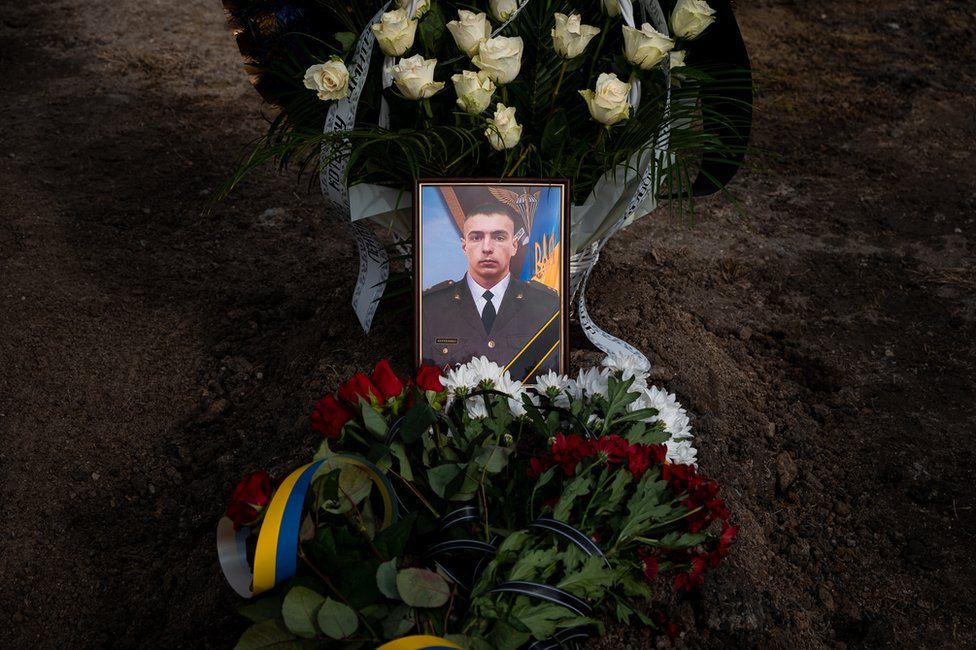
Dmytro Kotenko died near the southern city of Kherson and was buried in Lviv, safe for now from falling bombs
The BBC's Joel Gunter uncovered the story of a young Ukrainian soldier killed in the early days of the invasion.
Dmytro Kotenko, 21, was buried hundreds of miles from his family, who are stuck in the northern city of Sumy, cut off from the outside world.
Kotenko's childhood friend Vadym Yarovenko was the one who broke the news to Kotenko's parents - it took him all night to work up the courage to make the call to tell them he had died.
When he tried to call later about the funeral, the aerial bombardment of Sumy had worsened and the line would not connect. He kept trying but the line stayed dead.
The sole mourner at his funeral, Yarovenko said it was the saddest thing he had ever experienced.
"I watched my friend being buried far from his home," he said.
He hopes he can speak to Kotenko's parents again. And he says his will carry the memory of his friend as he waits for his own turn to fight on the frontline.

Russia's stock market has partially resumed trading after a nearly month-long suspension because of the war.
Only bonds issued by the Russian government can be traded as part of a phased re-opening of the market.
Andrei Braginsky, a spokesman for the Moscow Exchange, said he hoped that trading in stocks would be able to start again soon.
The invasion and sanctions imposed by Western governments are taking a toll on the Russian economy.
Some supermarkets are rationing sales of basic goods such as salt and cooking oil.
Reports from across the country suggest sugar and other staples are being restricted.
However, deputy industry and trade minister Viktor Yevtukhov insists "there is no problem with sugar".
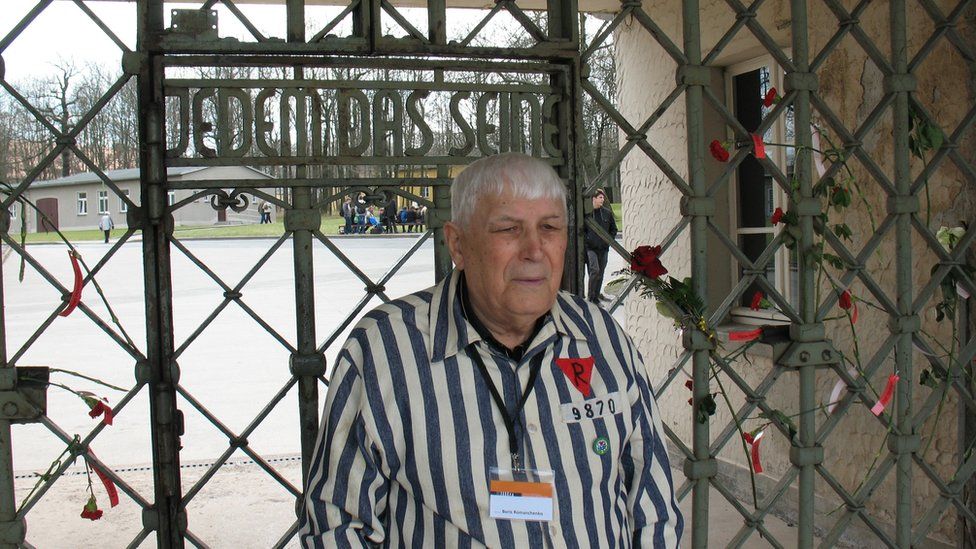
Boris Romantschenko survived detention in four separate concentration camps between 1942 and 1945
Boris Romantschenko survived the Nazi Holocaust, spending time in Buchenwald and several other camps.
But at the age of 96 he was killed by Russian shelling of his apartment block in the Ukrainian city of Kharkiv on Friday.
The Buchenwald and Mittelbau-Dora Memorials Foundation, of which he was vice-president, announced the death on Monday, saying it was "deeply disturbed" by Mr Romantschenko's death.
It said he had "worked intensely on the memory of Nazi crimes".
"We mourn the loss of a close friend. We wish his son and granddaughter, who brought us the sad news, a lot of strength in these difficult times," the foundation's statement added.
Russian forces have been relentlessly shelling Kharkiv, which lies just 30 miles (50km) from the border, for over three weeks.
Holocaust survivor killed in Ukraine shelling
Copyright © Newyork Daily © 2021